

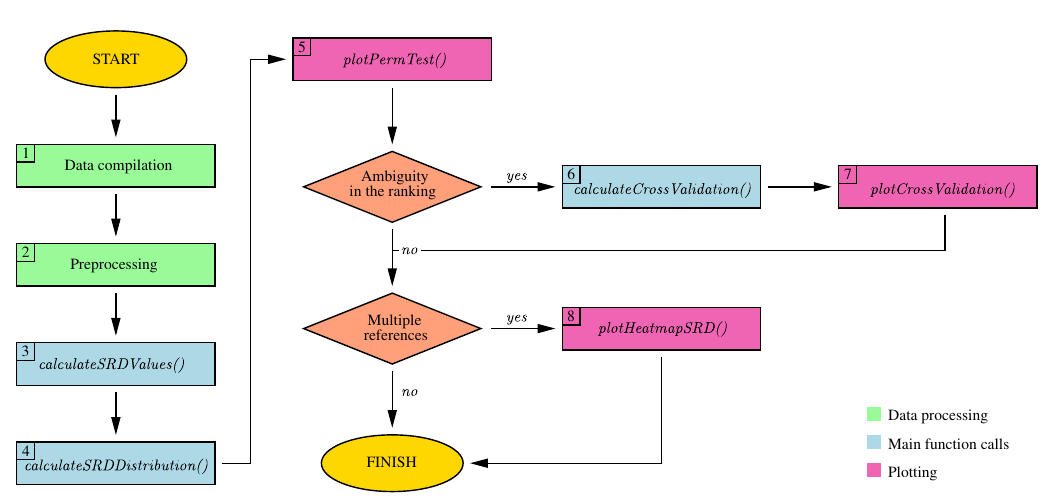

rSRD: An R Package for the Sum of Ranking Differences Statistical Procedure – new research article by Balázs Sziklai in R Journal
rSRD: An R Package for the Sum of Ranking Differences Statistical Procedure Balázs R. Sziklai, Attila Gere, Károly Héberger and Jochen Staudacher The R Journal Vol. 18/3, September 2026 – pp 97-119 Abstract: Sum of Ranking Differences (SRD) is a relatively novel, non-parametric statistical procedure that has become increasingly popular recently. SRD compares solutions via […]
Paying farmers to be greener does not necessarily change how they farm – by Imre Fertő and Štefan Bojnec

Paying farmers to be greener does not necessarily change how they farm Imre Fertő and Štefan Bojnec European agricultural policy increasingly relies on financial incentives to encourage farmers to adopt more environmentally sustainable practices. Rather than simply regulating agricultural production, governments pay farmers to undertake voluntary commitments intended to protect biodiversity, improve soil and […]
European Parliament intergroups as channels of local and regional government interest representation – Balázs Brucker

Incentivising sustainable fertiliser management: dynamic causal evidence from Hungarian farms – new research study by Imre Fertő and Štefan Bojnec

Incentivising sustainable fertiliser management: dynamic causal evidence from Hungarian farms Imre Fertő & Štefan Bojnec Environmental Sciences Europe – Published: 9 October 2026 Abstract Agri-environment-climate schemes (AECS) are intended to encourage farming practices that protect natural resources while sustaining agricultural production. This study examines whether participation in the Hungarian AECS was associated with changes […]
Development in translation: everyday statecraft, housing as social infrastructure, and the production of racialised deservingness – new study by Tünde Virág in Geoforum
Development in translation: everyday statecraft, housing as social infrastructure, and the production of racialised deservingness Tünde Virág Highlights Develops the concept of everyday statecraft to explain how development is translated across scales. Reconceptualises housing as social infrastructure assembling material provision, governance practices, and social relations. Brokers are drivers of institutionalised discretionary governance through everyday administrative […]
Landed estates and cottage provision in rural England: The Manvers Estate, Nottinghamshire in the 19th and early 20th century – new research study by György Mikle and Charles Watkins
Landed estates and cottage provision in rural England: The Manvers Estate, Nottinghamshirein the 19th and early 20th century György Mikle and Charles Watkins Published online by Cambridge University Press: 1 October 2026 Abstract This paper investigates changing housing provision in rural Nottinghamshire during the 19th and early 20th centuries using archival material and historical census […]
Hungary’s Border Sections After the Schengen Opening – new co-authored article by Horeczki Réka in Modern Geográfia journal

Hungary’s Border Sections After the Schengen Opening: Integration Potential in the Context of Population Concentration and Urban Gravity Szilágyi Ferenc – Pénzes János – Horeczki Réka Modern Geográfia, Vol. 21, Issue 4, 2026: 111–132 With Croatia’s accession to the Schengen Area in 2023, followed by Romania’s in 2025, Hungary’s border regions have once again […]
Sustainable food choices are not simply a matter of taste – by Imre Fertő

Sustainable food choices are not simply a matter of taste Imre Fertő Research with 1,031 adults in Hungary suggests that people’s commitment to sustainable food develops in layers. Taste, freshness and trust are common starting points; social influence, environmental concerns and support for farmers reveal where stronger commitments begin. Choosing food is an everyday […]
Mapping Layers of Sustainability Consciousness in Food Consumption Using the Item Response Theory (IRT) Approach
by Zoltán Bakucs, Lajos Baráth, Zsófia Benedek, Imre Fertő, László Sipos
Wage insurance against short-term sales changes – new research paper by Róbert Károlyi has been published in Economica journal
Wage insurance against short-term sales changes Róbert Károlyi Economica – Volume93, Issue372 – Special section: Economy 2030 Symposium – October 2026 – Pages 1206-1224 – First published: 28 April 2026 Abstract In this paper, I study how the wages of job-stayers respond within the year to changes in firm sales, using quarterly matched employer–employee data from […]