




Efficiency in the Olympic Games: The Role of Mobility and Inequality – new study by Gergely Csurilla, Imre Fertő and Lajos Baráth

“This study examines how effectively countries convert their economic and demographic resources into Olympic success. Using data from the 1996–2020 Summer Games and a random-parameter stochastic frontier model, we find that the average country operates at only 68% of its attainable performance frontier, and that sports diversification – competing across a broader range of disciplines […]
Hungary: The Allied Outlier – book chapter by Boglárka Koller in Springer’s Security, Defence, and the Future of Europe
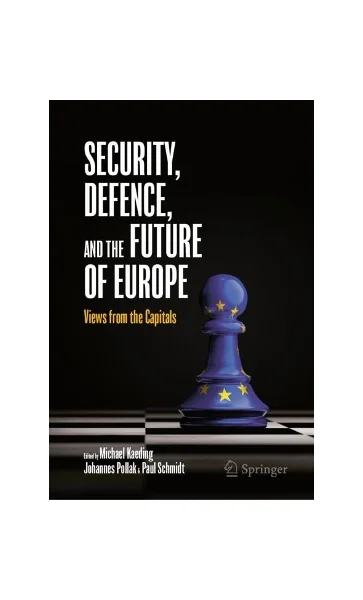
Security, Defence, and the Future of Europe Views from the Capitals Editors: Michael Kaeding, Johannes Pollak, Paul Schmidt © Springer Nature Switzerland AG 2026 This book provides a panoramic and comparative view of how Europe is currently redefining its security and defence in an age of renewed geopolitical tension and uncertainty. After Russia’s full-scale […]
How are the interests of local and regional governments represented in the European Parliament? – Balázs Brucker

The green leap forward? State capitalism, industrial policy, and the limits of green transformation in China – new scientific study by Ágnes Szunomár in Post-Communist Economies journal
The green leap forward? State capitalism, industrial policy, and the limits of green transformation in China Ágnes Szunomár Post-Communist Economies – Published online: 26 May 2026 Abstract China’s rapid expansion in green industries – the green leap forward – is frequently cited as evidence of the effectiveness of state-led industrial policy in accelerating technological upgrading and […]
The employment effects of disability benefit reassessment – new co-authored study by Anikó Bíró and Judit Krekó is published in Jornal of Public Economics
The employment effects of disability benefit reassessment Anikó Bíró, Cecília Hornok, Judit Krekó, Dániel Prinz, Ágota Scharle Journal of Public Economics – Volume 259, July 2026 Highlights We study a disability insurance reassessment reform in Hungary using variation generated by a birthday cutoff. In line with a perceived threat of benefit loss, recipients reduced work […]
Digital and Circular Transition Pathways in European Manufacturing: A PRISMA-based Review – new co-authored study by Viktor Varjú in Circular Economy and Sustainability journal
Digital and Circular Transition Pathways in European Manufacturing: A PRISMA-based Review Wifek Essoussi, Kinga Nagyné Pércsi & Viktor Varjú Circular Economy and Sustainability – Volume 6, article number 242 (2026) – Published: 11 May 2026 Abstract The shift towards sustainability in European manufacturing has […]
Changing functions of allotments and their regulatory challenges in Hungary – Gábor László Vasárus, József Lennert, András Donát Kovács, Ádám Szalai

Restructuring of the state-market relations in Turkey: An analysis of infrastructure failures in the transportation sector – by Ágnes Szunomár

Restructuring of the state-market relations in Turkey:An analysis of infrastructure failures in the transportation sector Over the past two decades, Turkey has invested heavily in large-scale transport infrastructure projects to showcase economic strength and modernisation. New bridges, highways, airports, and high-speed rail lines have become central elements of political communication and development strategy. However, […]
Urban Interest Representation in the EU: Opportunities, Channels, and Constraints – Evidence from Hungary – Balázs Brucker

Reclaiming the margins in environmental research: Epistemic inequalities across Europe’s geographical and disciplinary peripheries
co-authored article by Viktor Varjú, Dóra Bálint and Gergely Tagai